spclinichennur@gmail.com
Phone : +918095306888
Best Spine Surgeon in Bangalore
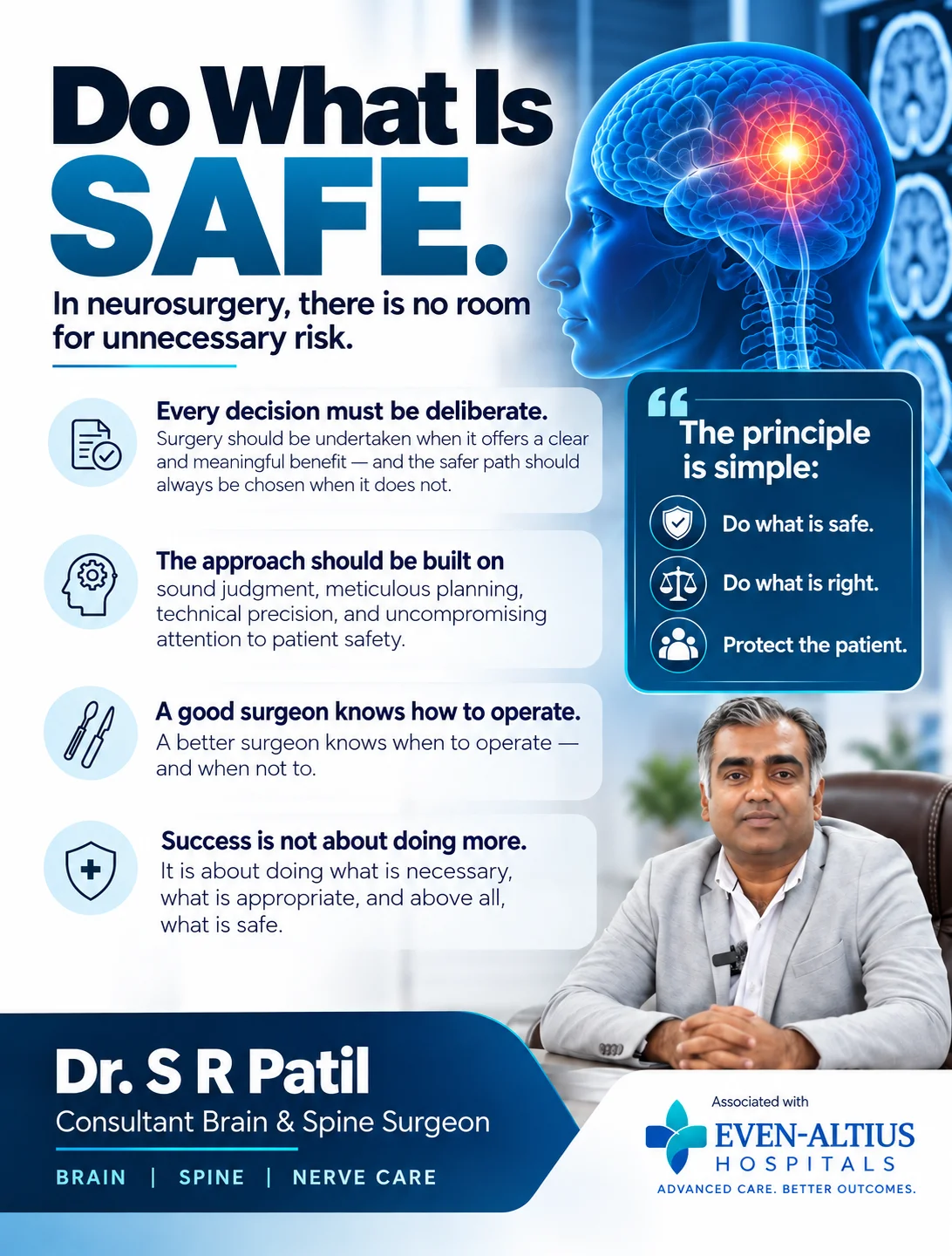
Do What Is Safe: A Patient-Centred Approach to Neurosurgery
Neurosurgery involves some of the most delicate and complex areas of the human body. Conditions affecting the brain, spine and nerves often require careful evaluation, detailed planning and thoughtful decision-making.
For a neurosurgeon, the goal should not simply be to perform a procedure. The larger responsibility is to determine whether surgery is necessary, what approach is appropriate, and how the patient's safety can remain at the centre of every decision.
Every Decision Must Be Deliberate
Surgery should be considered when the expected benefit is clear and meaningful for the individual patient.
Before recommending a procedure, several factors may need to be considered, including the patient's condition, symptoms, diagnostic findings, treatment options, potential benefits and possible risks.
In some situations, surgery may be appropriate. In others, observation, medication, rehabilitation or another non-surgical approach may be considered.
The important principle is that treatment decisions should be based on the individual patient's clinical situation rather than on a one-size-fits-all approach.
Planning Is as Important as Technique
Neurosurgical procedures require meticulous preparation.
A carefully planned approach considers the relevant anatomy, diagnostic information, surgical objectives and potential risks. Technical precision is important, but it works alongside clinical judgment and careful preparation.
Patient safety should remain an important consideration throughout the treatment process — from diagnosis and decision-making to surgery and recovery.
Knowing When to Operate — and When Not To
One of the important responsibilities of a surgeon is understanding that surgery is not automatically the answer to every problem.
A good surgeon knows how to operate.
A better surgeon knows when to operate — and when not to.
The decision depends on the individual patient's condition and the potential balance between expected benefit and risk.
When surgery is indicated, the objective is to perform the appropriate procedure with careful planning and precision. When surgery is not necessary, avoiding an unnecessary procedure can itself be an important part of responsible patient care.
Success Is Not About Doing More
In healthcare, more treatment does not necessarily mean better treatment.
The focus should be on providing what is necessary, what is appropriate and what is safe for the patient.
This patient-centred philosophy encourages thoughtful evaluation rather than rushing toward an intervention.
A Simple Principle
The philosophy can be expressed in three simple principles:
Do what is safe.
Do what is right.
Protect the patient.
For patients dealing with brain, spine or nerve-related conditions, a detailed clinical evaluation can help determine the most appropriate treatment pathway.
Dr. S R Patil
Consultant Brain & Spine Surgeon
Brain | Spine | Nerve Care
Associated with Even-Altius Hospitals
Tag
Best Spine Surgeon in BangaloreEnquiry
Get in touch



S P CLINIC.All Rights Reserved © 2026